- Astronomy is a field of science and it involves the study of the nature and motion of objects in the Universe, which includes the Sun, planets, stars and galaxies.
- Many early civilisationnoticed that the stars and planets regulary changed their arrangement or movement. These observation contributed to superstitions and were incorectly used to predict future events.
- The Arabs, Chinese Egyptians and Greeks were the early astronomers who studied the stars, planets and phenomena such as eclipse.They recorded their observatoins care fully and systematically.For example, the Greeks grouped the star into constellations.
- ARISTOTLE (384-322 BC), the Greek astronomer, was the first peson to suggest that the Earth is spherical. PTOLEMY, another Greek astronomer, suggest in 200 AD, that the Earth is the centre of the Solar System.
- NICOLAUS COPERNICUS (1473-1543) is regarded as the 'Father of Modern Astronomy'. In 1543, he claimed that the Sun is the centre of the Solar System and the Earth orbits the Sun.
- HANS LIPPERSHEY (1570-1619), the Dutch optician, invented the telescope in 1608. The invention contributed greatly to development in the field of astronomy because it helped astronomers observe distant object.
- JOHANNES KEPLER (1571-1630) suggested that the planets moved around the Sun in ellipses and not circles. He suggested that physical force that moved the planets around the Sun become smaller the futher away the planets were from the Sun.
- Galileo Galilei (1464-1642) an Italian astronomer was the first person to make significant observation using the telescope. He discovered the mountains and craters of the Moon, the spot on the Sun, the phases of Venus, the satellites of Jupiter and the Stars in the Milky Way galaxy.
- Isaac Newton (1643-1727) who described the three laws of motion suggested that gravity had an effect on planetary orbits. He explained that the force of gravity ensured the planets travelled in elipptical orbits.
- EDMUND HALLEY (1656-1742) noted that the comets observed in 1456, 1531, 1607 and 1682 followed similar orbits and each appeared 76 years after the preceding one. Such comets were named Halley's Comet.
- In 1932, an American engineer Karl Jansky, invented the radio telescope. A radio telescope detects radio waves that are emitted from distant planets or objects. In addition, it tracks and collects data from satellites.
- In 1990, the Hubble Space Telescope was launched into space .This is a powerful telescope which orbits the Earth.This telescope provides clearer images compared to ground based telescopes because the images are not blured by the Earth's atmosphere , or by background light scattered in the atmosphere. Many important discovaries in astronomy have been made with the images captured by this telescop.
Isnin, 21 Disember 2009
Development in the Field of Astronomy
Space Exploration
INTRODUCTION
Development in the field of astronomy and space exploration helped man to learn more about the Universe and improve the quality of life on Earth.
Jumaat, 18 Disember 2009
SKY MAPS
Sky maps are used to located stars and other objects in the sky just like a world map is used to locate countries, states and cities.
There are many types of sky maps just as there is may types of land maps. Sky maps cover various amounts of the sky. One of the most useful sky map is a sky map that shows the entire sky that can be seen at once. This assumes you have unobstructed veiwing horizons. These sky maps are implemented as circle sky maps with the horizon at the edges of the circle sky map and the point directly overhead is located at center of the circle sky map. The point directly over head is called the zenith. Half way from the center of the circle sky map (zenith) to the circle sky map edge (horzion) is same as viewing the sky half way fron directly overhead to the horizon.
A world map is used to learn the locations of countries and major cities of interst. Simularly, the circle sky maps are use to learn the locations in the sky of constellations and bright stars. To keep the circle sky map useable only the bright stars are shown. Just like we have country boundaries on a world map so has the sky been divieded into areas called constellations. The complete sky is divided into 88 constellations. The constellations vary in size and shape.
The English pronunciation of the name Pleiades depends on the speaker.
Canadian English: /ˈpleɪ.ədiːz/ PLAY-ə-deez
Other notable names of Pleiades include:
الثريا (al-Thurayya) in Arabic
כִּימָה (kimah) in Biblical Hebrew
Բազումք (Bazumq) in Armenian
ثريا (Sorayya) in Persian and Urdu
좀생이 (Jomsaeng-i) in Korean (usually suffixed with 별 byeol "star" or 성단
seongdan "star cluster")
昴(Subaru) in Japanese
Matariki in Maori
Kṛttikā in Sanskrit
Parveen (پروین) in Persian, Urdu and Indian
Vlašići in Croatian
Ülker in Turkish
Khamis, 17 Disember 2009
Pleiades (star cluster)

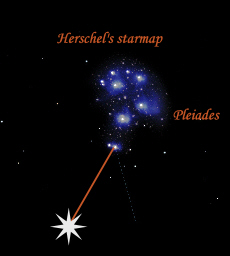

In astronomy, the Pleiades, or Seven Sisters, (Messier object 45) is an open star cluster containing relatively young hot B-type stars located in the constellation of Taurus. It is among the nearest star clusters to Earth and is the cluster most obvious to the naked eye in the night sky. Pleiades has several meanings in different cultures and traditions.
The cluster is dominated by hot blue and extremely luminous stars that have formed within the last 100 million years. Dust that forms a faint reflection nebulosity around the brightest stars was thought at first to be left over from the formation of the cluster (hence the alternate name Maia Nebula after the star Maia), but is now known to be an unrelated dust cloud in the interstellar medium that the stars are currently passing through. Astronomers estimate that the cluster will survive for about another 250 million years, after which it will disperse due to gravitational interactions with its galactic neighborhood.
Bintang merupakan bebola jisim gas yang terbentuk disebabkan tarikan graviti mereka sendiri. Cahaya bintang terhasil dari tindakbalas pelakuran nuklear di bahagian teras, di mana unsur hidrogen digabungkan untuk menghasilkan unsur helium, gelombang eletromagnetik, dan tenaga. Permulaan kelahiran bintang dipercayai daripada kepulan gas hidrogen dan debu angkasa yang membentuk Nebula.
Apabila debu dan gas berkumpul, daya gravitinya meningkat dan menarik lebih banyak debu dan gas daripada Nebula sehingga termampat dan membentuk bebola gas. Apabila bebola gas mempunyai daya tarikan graviti yang tinggi, tekanan meningkat menghasilkan suhu tinggi sehingga berlaku pelakuran nuklear gas hidrogen yang membebaskan helium, haba, dan cahaya.
Bintang terdekat dengan bumi adalah matahari pada jarak purata 149,680,000 kilometer, diikuti oleh Proxima Centauri dalam constellation Centaurus kira-kira empat tahun cahaya. Bintang dikelaskan melalui melalui spektrum cahaya yang dihasilkan yang menentukan warna nyalaan bintang, suhu, kecerahan, saiz, jisim, ketumpatan, dan komposisi kimianya.
Kecerahan bintang dibahagi kepada 1 hingga 6, dimana satu ialah bintang paling cerah, dan 6 sebagai bintang paling malap. Terdapat juga kecerahan yang diukur secara mutlak yang dikenali sebagai magnitud mutlak antara +26.0 sehingga -26.5. Saiz bintang menurut turutan kecil ke besar adalah Neutron < Kerdil (0.01 saiz Matahari) < matahari < Raksaksa < Superraksaksa bersaiz 400 kali matahari). Ketumpatan bintang bergantung kepada saiz bintang yang memberi kesan kepada graviti bintang.
Kandungan kimia bintang dikenalpasti menggunakan peralatan spektroskop. Apabila kandungan hidrogen di teras bintang kehabisan, teras bintang mengecut dan membebaskan banyak haba dan memanaskan lapisan luar bintang. Lapisan luar bintang yang masih banyak hidrogen mengembang dan bertukar warna merah dan dikenali sebagai bintang raksaksa merah yang boleh mencapai 100 kali saiz matahari sebelum membentuk bintang kerdil putih. Sekiranya bintang tersebut bersaiz lebih besar daripada matahari, ia akan membentuk superraksaksa merah. Super raksaksa merah ini kemudiannya membentuk Nova atau Super nova dan kemudiannya membentuk bintang neutron atau Lohong gelap.
GROUP ASTRONOMI MANIA
Hello semua..slamat pagi,,tgh hari,,malam..malam buta....pada tanggal 15hb/12/2009 ...aku dah join kumpulan ASTRONOMY MANIA..skarang ni..group ASTRONOMY MANIA dah ada 512 member...semuanya terdiri daripada astronomy2 yg terkemuka.ceh..kalo nak join mestilah ada facebook..dan mesti cakap indonesia..sbb ahli kelab itu terdiri drpd org indonesia..aku je sorang yang tersesat kat group tu..apa2 pon..join lah group nie...best!!♥ ♥ ♥
Langgan:
Ulasan (Atom)


